
The AI Analyst That Works With Your Data Like the Best Analyst on Your Team — Only Faster
About the Product
DataForge Analyst Agent is an intelligent AI-powered analytics agent that enables users to get answers to business questions through natural language dialogue. A user asks a question in plain language, and the system independently performs data exploration: analyzing database structures, using the semantic layer, generating SQL queries, validating results, and returning a complete analytical response with visualizations, tables, and interpretation.
Unlike traditional BI tools, where users are limited to predefined dashboards or require analyst involvement for ad-hoc requests, DataForge Analyst Agent acts as a full-fledged digital analyst. It does not simply answer questions — it understands business context, interprets metrics, validates hypotheses, and suggests further directions for analysis.
The result is a reduction in analytics delivery time from hours or days to seconds, while maintaining transparency and control over calculations.
Key Value
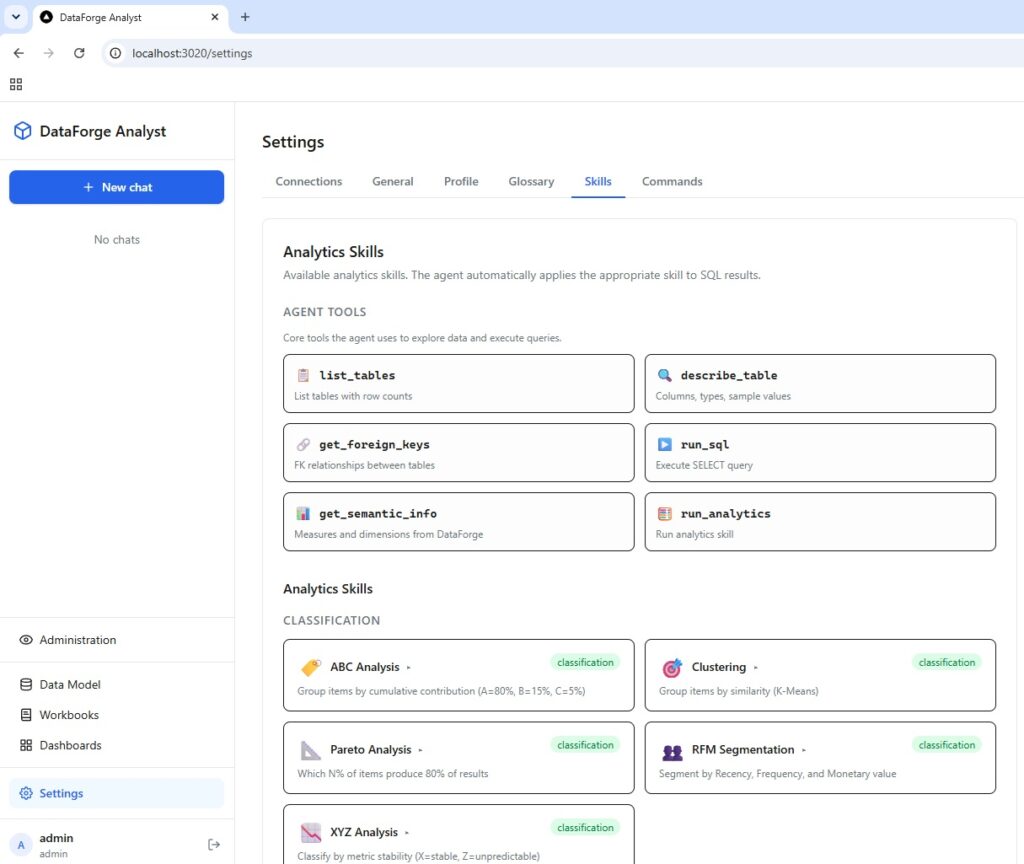
The core value of the product lies in shifting from an “analytics on request” model to an “analytics on demand” model. Users no longer need to wait, prepare technical specifications, or understand database structures. Any question can be asked directly — and answered immediately.
This fundamentally changes the operational model of working with data inside an organization:
- Executives gain direct access to analytics without intermediaries
- Business analysts accelerate research and hypothesis validation
- Product teams work with data in real time
- IT teams reduce the operational burden of analytical requests
At the same time, organizations maintain unified calculation logic, data quality control, and full transparency of the agent’s actions.
How It Works
The product is built around an Agent Loop architecture with Tool Calling — not a fixed pipeline, but a dynamic data exploration process where the agent independently selects the optimal strategy.
The workflow looks as follows:
First, the user asks a question in natural language. The agent interprets the request and determines which data sources and analysis methods are required. It then explores the database schema and semantic layer to understand available tables, relationships, and business metrics.
Next, the system generates an SQL query optimized for the specific task, executes it, and retrieves the result. The validation stage follows: the agent verifies completeness, correctness, and alignment with business logic.
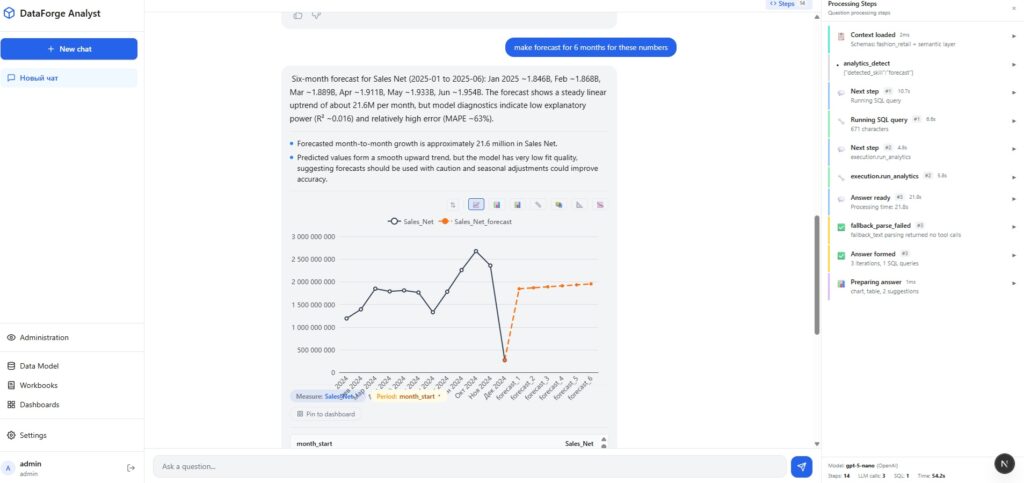
The final response includes not only raw data, but also interpretation: a textual summary, visualizations, tables, and additional insights. The system also automatically suggests follow-up questions, allowing users to continue the analysis without losing context.
Data Interaction Modes
DataForge Analyst Agent supports three operational modes that can be used independently or in combination.
Semantic Mode
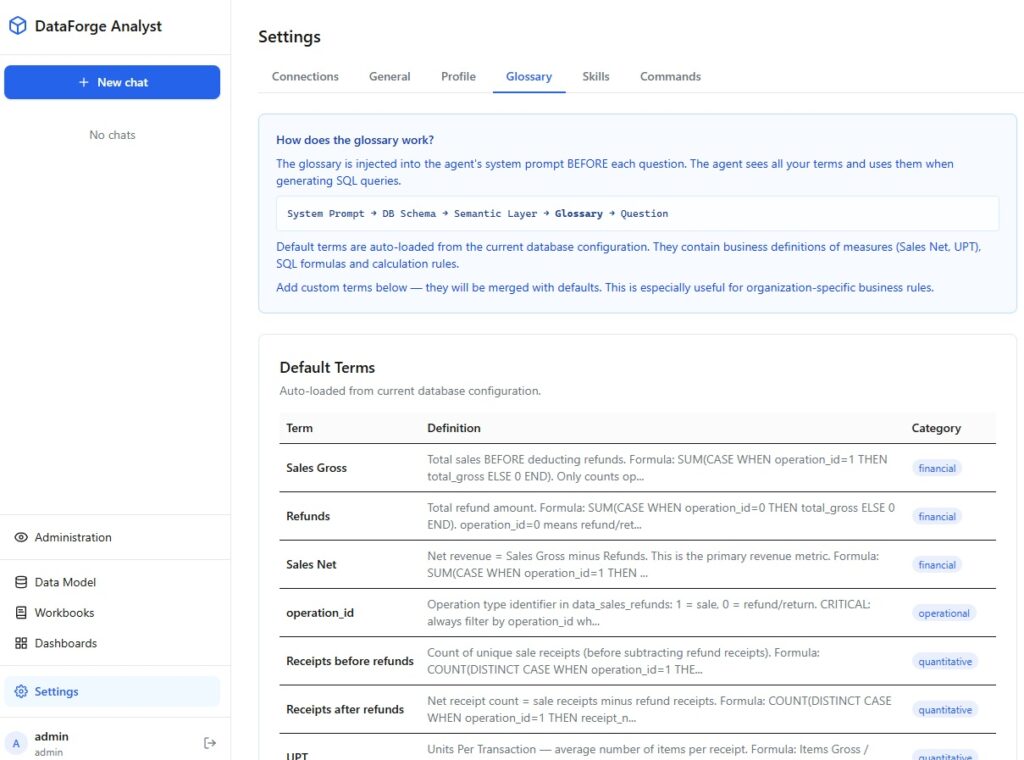
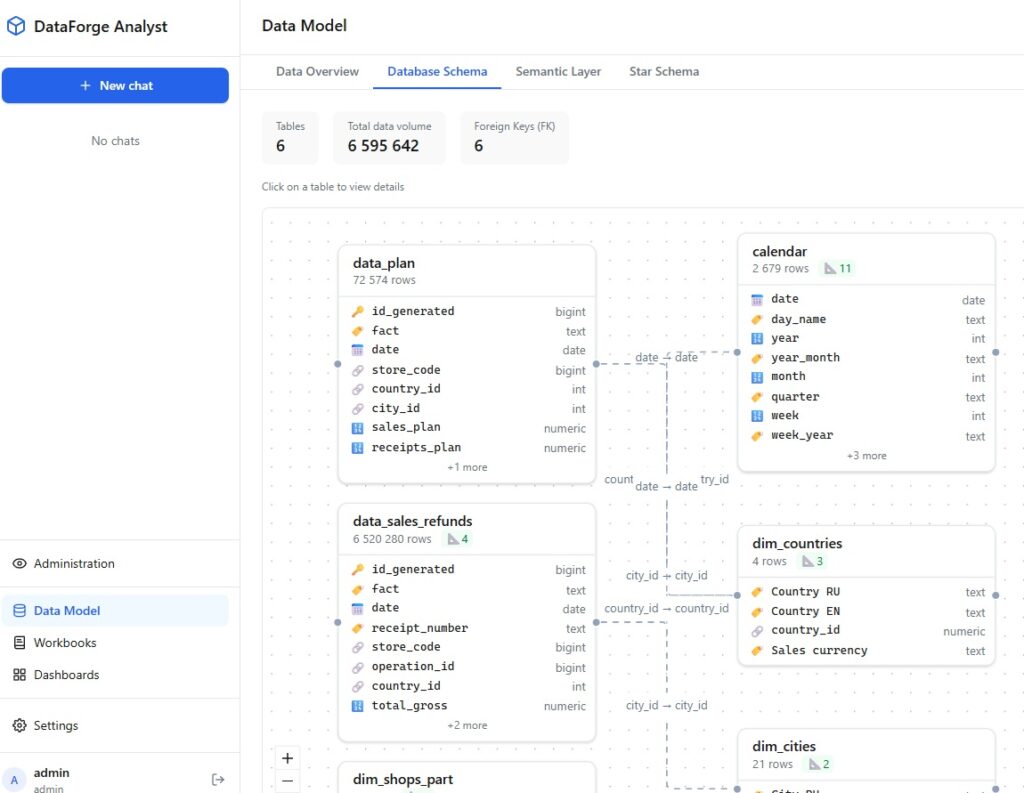
The agent accesses the semantic layer through the DataForge MCP Gateway and uses predefined business metrics, dimensions, and formulas. This ensures KPI consistency and eliminates discrepancies across reports. This mode is especially effective for standard management reporting.
Text-to-SQL Mode
For non-standard tasks, the agent works directly with the database, analyzes the schema, and generates SQL queries. This enables flexible ad-hoc analysis without the limitations of predefined data marts.
Hybrid Mode & Insight Discovery
The most powerful scenario combines semantic-layer understanding with direct SQL access to raw data. The agent first uses the semantic layer to understand business context and then enriches the analysis with SQL queries against underlying datasets. This provides maximum analytical depth and accuracy.
Functional Capabilities
The product implements the full analytics workflow — from question to insight.
The interface is built around conversational interaction, making analytics intuitive and natural. Users interact with the system the same way they would interact with an analyst — by asking questions and refining requests.
Automatic visualization selects the most appropriate chart type based on data structure, eliminating the need for manual chart configuration.
The system supports a multi-provider LLM architecture, allowing organizations to use both cloud-based models (OpenAI-compatible APIs) and local LLM deployments. This ensures infrastructure flexibility and compliance with security requirements.
Additional administrative capabilities include user management, role-based access control, query auditing, and system usage analytics.
Infrastructure Integration
DataForge Analyst Agent does not require rebuilding the existing data landscape. It integrates directly into the current architecture and works on top of existing systems.
The platform supports PostgreSQL and other analytical databases, allowing organizations to leverage existing DWH and lakehouse solutions.
The DataForge semantic layer acts as a unified source of business logic, ensuring metric consistency and interpretation alignment.
From an AI infrastructure perspective, the product supports both cloud and on-premise deployment scenarios, including production-grade inference optimizations such as continuous batching, KV-cache, and paged attention for high-performance workloads.
Security & Control
Special attention is paid to security because the system works directly with corporate data.
A multi-layered security model is implemented, including authentication, access control, SQL execution restrictions (SELECT-only), protection against SQL injection, and prompt injection attacks.
Additional safeguards include rate limiting, execution timeouts, and data volume controls.
Each user operates within an isolated context, ensuring data confidentiality and preventing information leakage.
AI Transparency
One of the key principles of the product is transparency.
Users can see exactly how the response is generated: which tables were used, which SQL query was executed, and which reasoning steps the agent performed. This eliminates the “black box” effect and increases trust in analytical results.
Each response is accompanied by the generated SQL query and an explanation of the logic, enabling validation and further reuse if needed.
Performance
The system is optimized for production environments and delivers fast responses even for complex analytical tasks.
A multi-level caching architecture is used: database schemas, semantic metrics, and conversational context are cached. This significantly accelerates repeated and related requests.
As a result, users receive responses within 10–30 seconds even when working with large-scale datasets.
Who This Product Is For
DataForge Analyst Agent is designed for a broad range of users working with data.
For business analysts, it becomes a tool for accelerating analysis while reducing dependency on SQL expertise. For executives, it provides direct access to business insights without intermediaries. For product teams, it enables real-time hypothesis testing and decision-making.
The product is especially valuable for organizations with strict data security requirements, as it fully supports on-premise deployments without transferring data to external cloud services.
